Go to the main content of this page

Message from the Director, Executive Officer, Executive Vice President & CTO

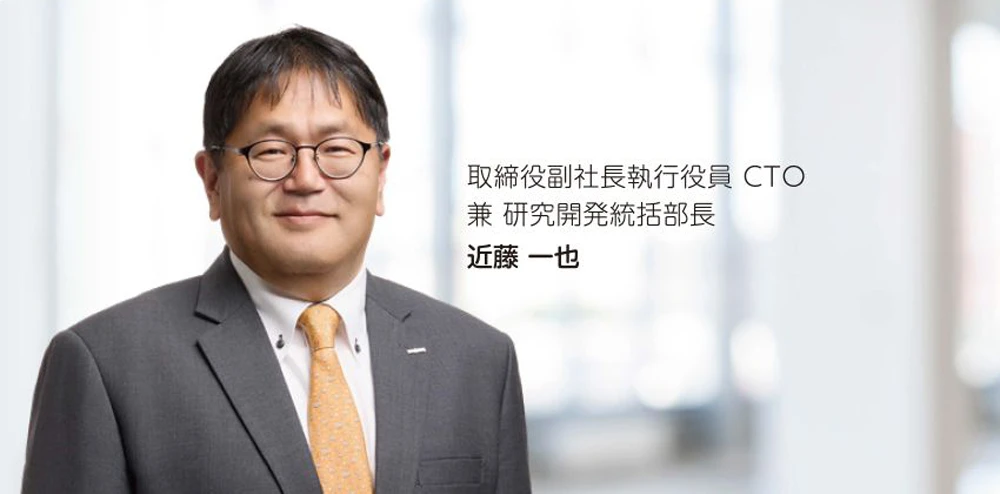
副社長執行役員 CTO 近藤 一也

Amid a rapidly changing business environment, while preserving our essential values, I will lead transformation from a technological perspective and contribute to creating new value, all toward realizing “Joy for Life—Bringing Joy to the Future by Food.”

My Convictions upon Assuming the Role of Executive Vice President and My Mission as CTO

On April 1, 2025, I was appointed executive vice president & CTO, and on June 25 I became a director. I joined the Company in 2023, and initially I was an executive officer responsible for research and development. In FY2024, in addition to R&D, I also oversaw dX* and the IT division. With the recent changes to our management structure, I now oversee a broad range of areas, including manufacturing, quality assurance, procurement, oil meal & bulk oil sales, oil milling management, and aspects of supply chain management such as distribution. My experience has been shaped primarily through production sites and R&D both in Japan and overseas. During my previous posting in Brazil, I also served as executive vice president, where I was responsible for production, technology oversight, and DX. Drawing on this knowledge and skill set, I want to lead transformation from the technological side and contribute to creating new value so that, even amid a rapidly shifting business environment, our company can continue moving toward the realization of “Joy for Life—Bringing Joy to the Future by Food.” At the same time, J-Oil Mills is a time-honored Japanese company with a history spanning nearly 200 years. The technologies that have been passed down, along with values of safety, security, and quality, must also be preserved. Striking a balance between protecting what must be preserved and driving change, I will work with the management team to share issues and execute our growth strategy.
* We write “dX” with an emphasis on the “X” to highlight “transformation in operations” as the true objective, rather than focusing just on the tool of digitalization.

Contributing to the Well-Being of All through Food Safety and Security

From a medium- to long-term perspective, we recognize and address issues while aiming to enhance corporate value. In the production division, we place the highest priority on the manufacturer’s responsibility of stable supply and food safety and security. We have set “contributing to the well-being of all through food and safety” as one of our materiality themes. To meet society’s expectations for safety and security and to ensure stable supply, we are continuously making capital investments and fulfilling our responsibility for stable production at six plants in Japan and one plant overseas. While safety can be achieved through scientific approaches, security ultimately depends on customers feeling it for themselves. For this reason, we have built management systems across all processes of delivering our products to customers, and we are working to improve quality. Furthermore, to contribute to the wellbeing of all people, it is essential to address health and diverse needs. In addition to disclosing information on raw material origins and food allergens, we recognize that expanding halal and kosher compliance is also an issue given customer diversity, and we are examining these options. Through these initiatives, we intend to continue providing not only safety but also peace of mind to customers.

Rendering of planned R&D facility (exterior view)

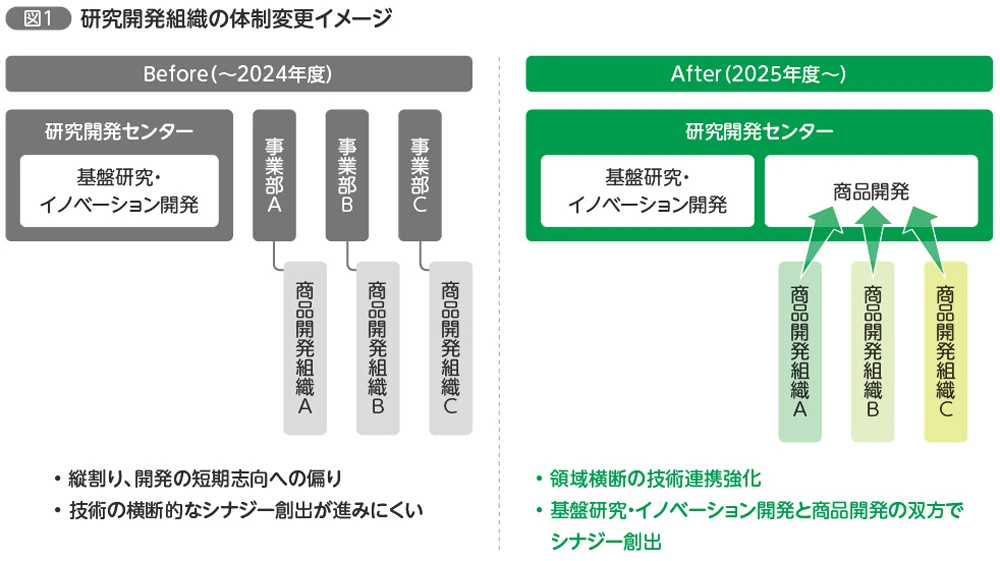
In the R&D department, we are continuously refining our strength in “Oishisa Design (creating deliciousness)” and working on technology and product development. Our research areas span a wide range, from core technologies to product development, application development, and containers and packaging. Among these, product development and application development are positioned as priority areas, as they are drivers for enhancing the technological capabilities and materials essential for advancing “Oishisa Design.” To respond quickly to customer needs and requests, we have emphasized collaboration with the sales division and placed product development units within each business division, a structure that has been highly regarded. At the same time, we were aware that relying solely on our existing technological capabilities and materials could eventually lead to stagnation. To ensure that R&D contributes to medium- to long-term business growth, in 2025 the management team integrated the functions of the R&D organization. In addition, we decided to consolidate our three existing R&D sites and relocate them to the city of Kawasaki, Kanagawa Prefecture, in January 2027. Through this integration, we aim to invigorate innovation by strengthening collaboration among research domains, generate synergies such as enhancing responsiveness to cross-divisional projects and improving productivity, and further reinforce our R&D capabilities.

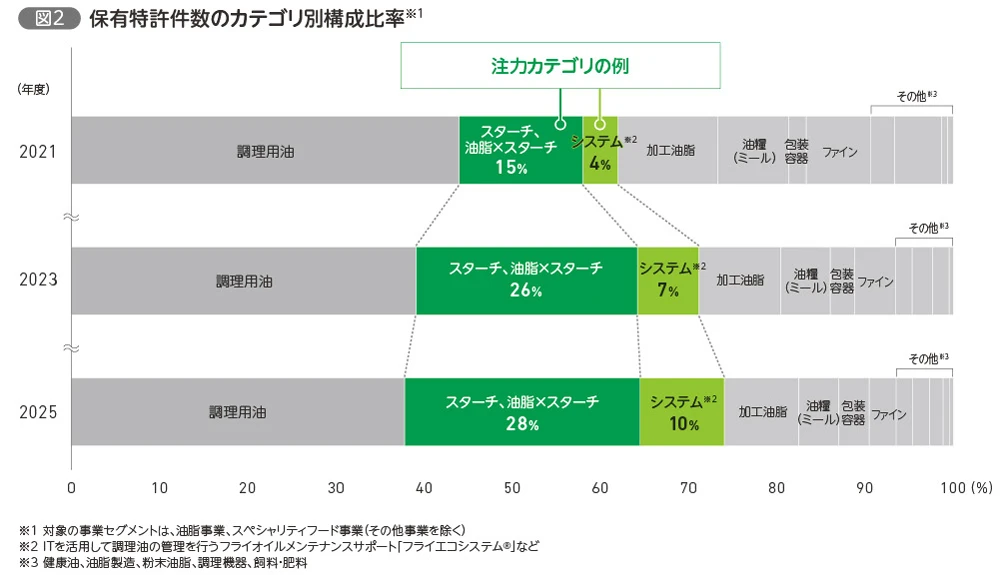
Within the R&D department, we have established a dedicated unit for intellectual property. Generally, IP activities have both a defensive aspect—patenting advantageous technologies to protect them from infringement—and an offensive aspect—leveraging technologies to advance R&D and business. In 2023, our number of patent registrations was 38, ranking sixth in the food chemistry field (source: Japan Patent Office, Annual Report on Patent Administration 2024). However, in order to advance business offensively through intellectual property, it is important not only to increase the quantity but also to improve the quality of our patents. 

As for next-generation technologies and businesses, we plan to launch new projects in FY2025 that leverage our technologies. Safety assurance is essential, but we intend to start small and without delay. We are also continuing to pursue fundamental next-generation technologies such as alternatives to oils, which could represent both business opportunities and threats for us.

Realizing a Sustainable Society through Stable Food Supply

For our company, which creates products from the bounty of nature such as soybeans and rapeseed and delivers valuable goods to customers, sustainable procurement of raw materials is essential. In recent years, the risks of sharp price fluctuations in raw materials have risen due to the impacts of climate change. Moreover, because we procure nearly all of our raw materials from overseas, we must be mindful not only of social ethics, legal compliance, and fair trade, but also of addressing global social issues such as environmental destruction, human rights violations, and forced labor. Supply chain management requires that the entire supply chain be sustainable, and society demands that we continue initiatives that stay one step ahead. Supplying edible oils—indispensable to people’s daily lives—and supporting food are the values and purpose of our company. Going forward, we will continue to work with business partners and relevant institutions, while making use of opportunities for dialogue with raw material producing countries. 

Traceability is also important in terms of appropriate management. We procure raw materials through local collection and export agents as well as trading companies. To ensure procurement in line with our “Sustainable Procurement Policy and Standards,” we have been advancing the signing of contracts that include sustainability clauses, and have completed such agreements with nearly all of our raw material suppliers. In addition, we are conducting surveys of suppliers handling other materials to confirm the status of their sustainability initiatives. We will continue to carry out regular surveys and work to build a responsible supply chain.

Promotion of dX

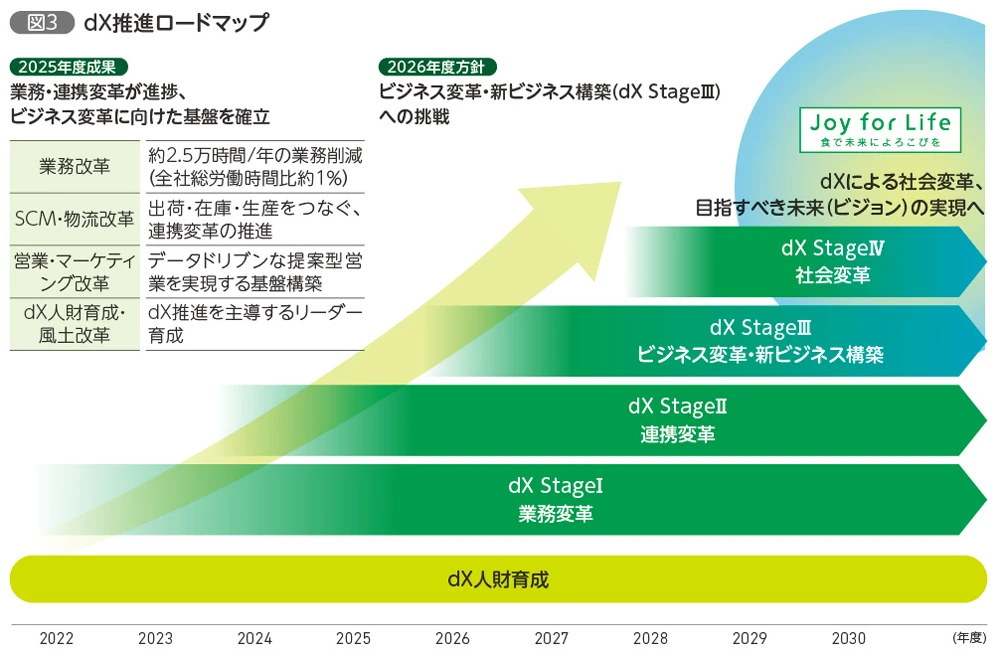
dXの推進の図

To realize the future set out in our corporate philosophy system and to fulfill our mission, we have defined our target vision for dX as “Utilizing digital technologies such as AI and IoT to transform businesses, products and services, and business models, and to establish competitive advantage.”

In April 2024, as project leader, I launched the “dX Promotion Project.” We set four stages: business process transformation, collaborative transformation (inside and outside the Company), business transformation / new business development, and social transformation. We began by working on business process transformation and collaborative transformation, setting themes for each. This approach stems from my experience overseeing DX in my previous position, where I learned that business transformation cannot be achieved without first implementing business process transformation and collaborative transformation. However, the stages we have set are not intended as steps to be climbed sequentially, but rather as elements that accumulate in combination. While I believe there are still issues to be resolved before reaching the level I expect, and that it will take time, I recognize that progress has been steady. From experience, I also believe that as collaborative transformation advances, new business possibilities often come into view, and I have high expectations in that regard. In 2025, we will continue initiatives on collaborative transformation and aim to raise themes for business transformation by identifying several seeds of new business, leading to initiatives starting in 2026. The intent behind setting social transformation as the final stage is that by driving business transformation through dX and delivering social value, we will contribute to realizing the future we aspire to—“Joy for Life—Bringing Joy to the Future by Food”— which will ultimately lead to social transformation.

As for themes under business transformation, discussions are still underway, but one example under consideration is deepening “Oishisa Design.” This might involve building a business model that addresses customers’ latent issues by systematizing and creating a database of solution proposals, the driving force behind “Oishisa Design.” For example, by combining oils and starches we can currently achieve textures such as crispiness or juiciness, verified mainly through sensory evaluation. On the other hand, scientifically clarifying the basis for these effects remains an issue. By converting such knowhow and scientific evidence into knowledge and creating a database, we can deepen the resolution of customer issues (through proposals for solutions to latent issues and the development of new applications), take on new markets and customers (active investment and human resource development in fields where we can leverage our strengths), and accelerate overseas expansion. All of these could potentially lead to business transformation. This is just one example of a potential theme, but during FY2025 we will discuss and set themes within the dX Promotion Project and move forward with initiatives accordingly.

To Our Stakeholders

To Our Stakeholders

In the years ahead, advances in new technologies and changes in the business environment may bring about major shifts in customer needs and values. Even in such circumstances, while fulfilling the responsibilities we have inherited as a food manufacturer over many years, we intend to boldly pursue transformation aimed at enhancing corporate value and provide new value to society.

I respectfully ask for your continued support.

Return to Integrated Report TOP