Biodiversity
Basic way of thinking
J-OIL MILLS Group's business is made possible by the bounty of the Earth, born from biodiversity, including agricultural products such as soybean, canola, palm oil, and olives. In addition, while we depend on natural capital and ecosystem services in various ways, such as the use of water resources and wastewater at our business sites, our business activities have a variety of impacts. We recognize that understanding these impacts and working to conserve and restore natural ecosystems is important for sustainable food and the sustainability of our business.
Our Group complies with all relevant laws and regulations related to biodiversity and responds appropriately to international standards and regulations. Furthermore, our basic policy in the "J-OIL MILLS Group Environmental Policy" is to strive for procurement that preserves ecosystems and contribute to the conservation of the natural environment, including biodiversity. Going forward, we will work with stakeholders outside the Group to conduct scientific research into the impact of our business activities on biodiversity and identify protected areas at our business sites.
Our Group will continue to coexist with nature and aim to realize a nature-positive society.
Relationship between biodiversity and our business
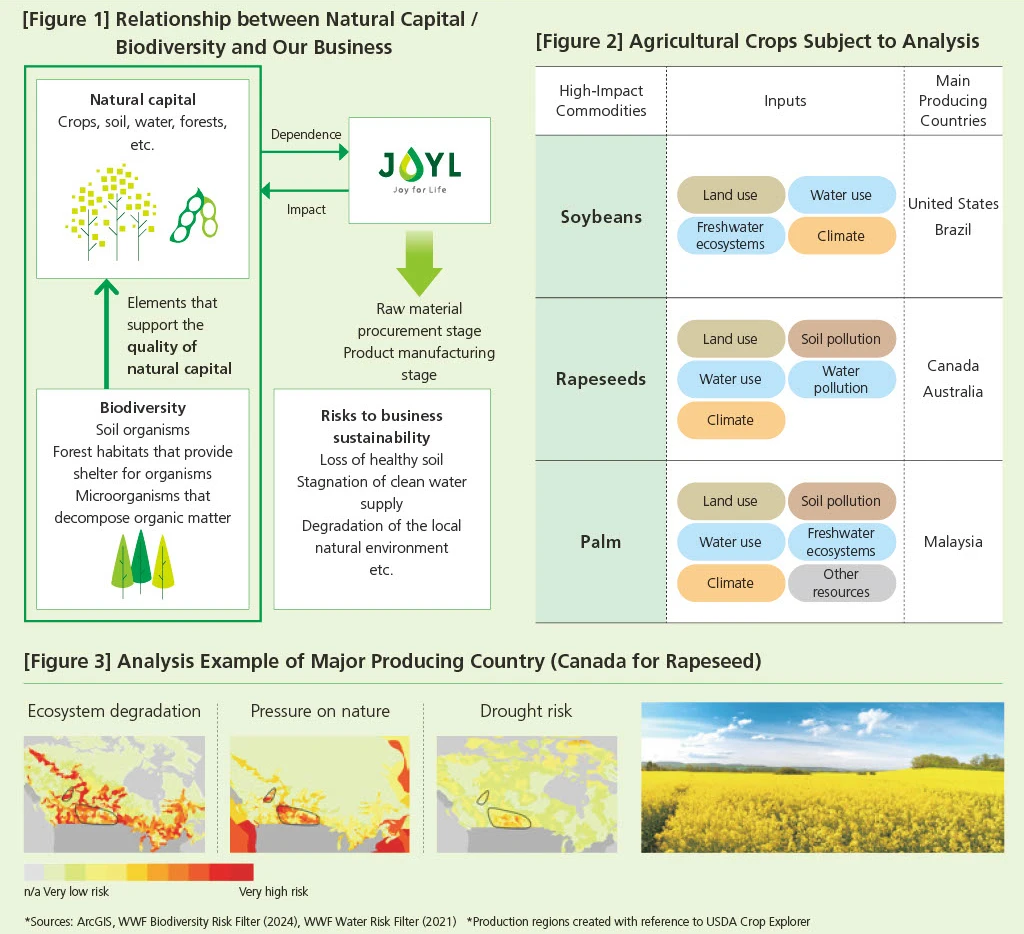
We analyzed the relationship between natural capital and biodiversity and our business throughout the entire value chain, including raw material procurement and product manufacturing (Figure 1). The agricultural products analyzed were selected based on their classification as high impact commodities, which are known to have a high environmental impact, their volume of handling, and their importance to our business (Figure 2). By visualizing the geographical relationship between each agricultural product and nature by country of origin using analytical tools (such as ENCORE*1), we found that ecosystem degradation and the burden on nature vary by country and region. Going forward, we will continue to analyze our Group 's dependence on natural capital, its impacts, and the risks and opportunities it faces, with reference to the LEAP approach*2 advocated by the Task Force on Nature-related Financial Disclosures (TNFD).
*1 Exploring Natural Capital Opportunities, Risks and Exposure. A tool that can assess the impact of a company's business activities on nature.
*2 Guidance for assessing nature-related risks and opportunities. Four steps are recommended: Locate (find connections with nature), Evaluate (diagnose dependencies and impacts), Assess (assess risks and opportunities), and Prepare (prepare for response and disclosure).
Supporting conservation and protection efforts
Our company joined the Japan Business Federation (hereinafter referred to as Keidanren) Nature Conservation Council as a regular member company in February 2023, with the aim of conserving biodiversity and promoting activities to protect the natural environment. did. We also support the Keidanren Biodiversity Declaration Initiative.
We also support the activities of the Keidanren Nature Conservation Fund, a public trust.
We will continue to participate in various projects, donate to NPOs and NGOs, and initiatives information between companies.