
Human Capital
Our approach to organization and human resources
September 2026
By strengthening human capital as the foundation supporting the enhancement of our business portfolio, we will achieve sustainable growth by integrating our human capital strategy and management strategy.
Integration of Management and Human Capital Strategy
As change in the business environment becomes the norm, the source of our ability to execute strategy lies in our people. Based on this recognition, the Company positions the advancement of human capital as an important management issue and is accelerating the execution of human capital strategies. In FY2025, we clearly positioned human capital strategy as part of our management foundation and worked to develop the necessary framework and advance its implementation. As part of these efforts, we established the Human Capital Committee, creating a framework for discussing human capital at the management level. This is driving a transition from the conventional approach of optimizing human resource measures by individual division to a structure in which management talent development, the human capital portfolio, workforce planning, and other matters are discussed in an integrated manner and decisions are made based on a human capital portfolio aligned with companywide strategy. In addition, by structuring the human capital strategy on the premise of alignment with materiality and management strategy, we are ensuring consistency among individual measures. By establishing common terminology, including definitions of talent requirements and evaluation criteria such as competencies, we have created a framework that enables objective and reproducible discussions without relying on individual judgment. We have established a decision-making process that links human capital strategy to enhancement of corporate value and are advancing human capital investment for the future, including development of management talent.
At the same time, visualization of the relationship between the alignment of individual human resource measures and the setting and achievement of KPIs on the one hand, and enhancement of corporate value on the other, remains a work in progress. We also recognize that for important themes such as health and productivity management and DE&I, in addition to clarifying initiatives and establishing priorities, quantitatively demonstrating their relationship with business growth remains a future challenge.
Enhancing Engagement and Organizational Autonomy
Through dialogue between employees and management, we strengthened connections between management policy and the front line and promoted a shared sense of organizational direction. As a result, engagement scores exceeded those of the previous year across all indicators, with improvements seen in questions relating to “trust in management” and “sense of accomplishment at work,” among others. We also confirmed steady progress in well-being and inclusion.
Meanwhile, challenges remain in terms of embedding the strategy and adapting to transformation, and we need to further strengthen efforts to translate management strategy into autonomous actions at the front line. Going forward, we will deepen two-way communication based on dialogue and continue transforming the organization so that each employee can proactively execute strategy.
Advancing Talent Development and the Human Capital Portfolio
To achieve medium- to long-term growth through dX and enhancement of the business portfolio, we have established a foundation for developing the talent needed to support these initiatives. To respond quickly to changes in the business environment and achieve data-driven decision-making and new value creation, it is essential to develop talent capable of understanding digital technology and business across organizational boundaries and driving transformation. In addition to improving digital literacy among all employees, we are strengthening the organization’s overall digital capabilities by progressively developing talent responsible for operational transformation and advanced analytics specialists. For management talent, we have established a talent pool and individual development plans and manage development, transfers, appointments, and promotions in an integrated and systematic manner. In R&D as well, we are taking the lead in visualizing the current situation using skill maps and competencies, establishing education plans and individual development plans, and managing the definition, development, and assignment of required talent in an integrated manner from a medium- to long-term perspective. Going forward, we will expand these initiatives throughout the Company. Through these efforts, we are expanding human capital investment that supports business transformation while further defining a companywide human capital portfolio with the next Medium-Term Business Plan in mind.
Initiatives on Human Rights and DE&I
We position respect for human rights as an important management issue directly linked to sustainable organizational growth, in addition to ensuring supply-chain stability and reducing reputational risk. We are strengthening our response through measures including employee interviews, surveys of overseas sites, and the introduction of risk assessments in raw material procurement. We are also working to ensure effectiveness through measures such as establishing consultation channels accessible to external stakeholders and developing remediation processes.
For DE&I, we are systematically advancing measures across a wide range of themes. While a certain degree of progress has been made in areas such as creating a more supportive work environment, challenges remain in achieving inclusion and linking the value contributed by diverse talent to corporate competitiveness. Going forward, we will strengthen the transparency and accountability of our initiatives by advancing human rights due diligence and enhancing disclosure, while clarifying their contribution to corporate competitiveness by linking the results of individual measures to the human capital portfolio and organizational performance.
Future Outlook
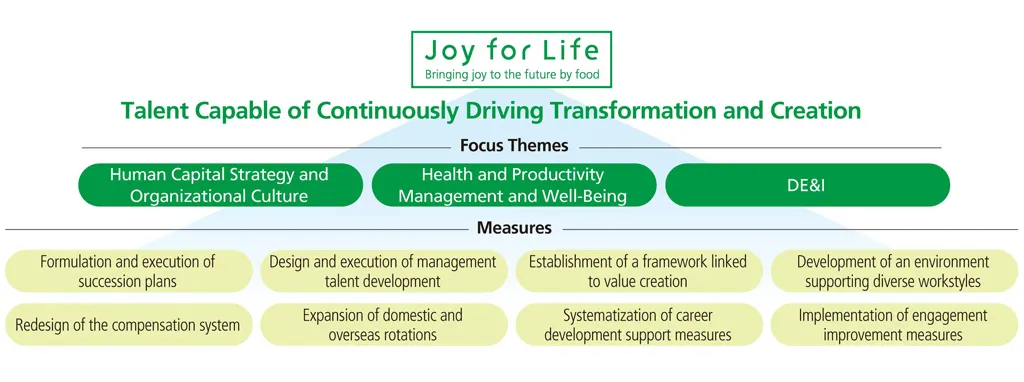
Human capital management is moving from the stage of building foundations to a phase in which it supports strategy execution. We will move our human capital and governance foundations into the implementation and operation stage and go beyond establishing systems by reflecting them in talent assignment, development, and evaluation, thereby aligning strategy with actions at the front line. Furthermore, by advancing our human resource systems and strengthening talent management, we will transform the organization so that each employee can execute strategy as part of their own work. Going forward, through more advanced management centered on people, we will enhance our ability to improve our business portfolio and aim to achieve sustainable enhancement of corporate value.
Human Capital Policy
Our Group regards human resources as our most important capital, and we believe that allowing each individual to maximize their individuality and capabilities and take on challenges and grow autonomously will lead to sustainable growth for the entire J-OIL MILLS Group.
To achieve our corporate vision of "Joy for Life®-Bringing joy to the future by food," we have established a human resources policy that outlines the goals we aim to achieve through our human capital management within the overall picture of our sustainability initiatives that are linked to the company's long-term strategy and growth investments.
